Get your FREE GUIDE '7 Steps to grow a Quilt Pattern Design Business'

the collision of chaos and creativity
Summer. Chaos in slow motion.
My desk is awash in piles of to dos and do not touches. And dirty dishes and cups.
My back log of ‘when you have a minute’ is at near bursting point in the dyke.
Different demands on my time and attention than during the rest of the year mean more fractured, less predictable time blocks.
Chaos is reigning.
I wish it was raining. It makes me feel contained and like I have no reason to go outside, so I can stay focused on inside. And get a hold of things. Get organized. Feel in control.
the struggle
I read Steven Pressfield’s article this week and thought that maybe I should stop struggling against the chaos. Not as an excuse to just not tidy up, but as the spark, the fuse, the juice, the fuel to my motion.
I see chaos as the detritus caused by making, by doing, by thinking, by scrambling towards the light.
I never stopped to look at it as being the initiator and not the resultant.
I am an engineer. I was an engineer. I trained as an engineer. Transitioning, reforming, changing, integrating this identity into … designer, artist, creative, creativity, textiles, life beyond the box.
So, I hang on to, I’m attached to this identity of someone who is organized, rational. Lists, check lists, check marks, progress, measurable, quantifiable. Maybe I need to stop measuring?
the measurement of time
I love Twyla Tharp’s outlook on distractions laid out in her book The Creative Habit. When we think of distractions we are sometimes limited to thinking of just limiting Facebook or TV or email for a while. But she even goes deeper. Remove all numbers. Even clocks. Time.
I realized when we went to stay at my brother in law’s house in Switzerland that I kept checking the loungeroom for clocks all the time. Not because we were in Switzerland, but because I am so used to checking the time all the time when I am at home. We have two clocks in the kitchen/living area. And I have one on the wall in my studio. And yes, time and time keeping is important and has its place, but is it also a distraction?
Time check:
oh gosh its 10 o’clock already – cue avalanche of distracting thoughts around – but I haven’t done xy or z yet
– it’s already time to go and ab or c
– oh I wonder what time it is in Australia where my family is…
This is distraction too, right?
At the time the lack of clocks in Switzerland irritated me, but now I wonder why I obsessively check the time all the time?
I am hooked. It’s a real addiction. An addiction to measurement. An addiction to linearity, an addiction to order, to direction. To control?
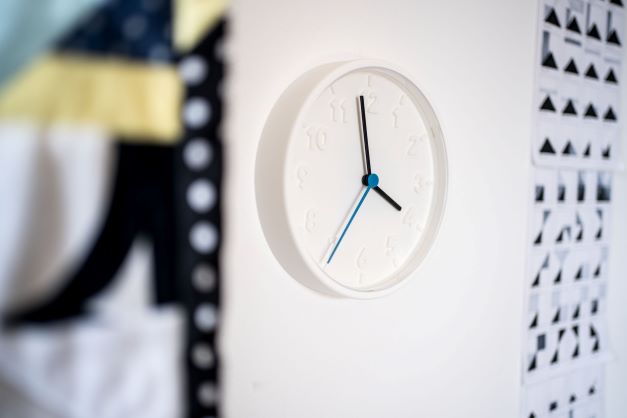
What if….
… I took away all the clocks.
What if…
… I succumbed to the chaos.
What would come of it?
A worthy experiment? What do you think? Should I try it? Have you tried it?
a comment by a reader of my journal:
So good.. wondered where you were going because isn’t symmetry and balance oh sooo beautiful! Thought you might touch on Chaos theory… that’s my balance that’s not balance. I do like the balance that’s unresolvable, for someone who also loves to SOLVE.. to figure out and nail it there is huge comfort in the idea that ‘That is exactly how its supposed to be.’
Riana c.
I was writing about balance.
Maybe I was considering the wrong thing. Maybe instead of balance I should consider UN-balance. Isn’t it always the eccentricity, the anomaly, the disruption that I like so much? Isn’t that chaos too?
The asymmetry, the uneven tile, the not quite straight line, the oops, an unexpectedly different color like the shade of brown that colors one of my daughters sea green eyes. The freckle on my daughter’s knee. The eccentricity of the world – 365.25 days. I was so close to being a 29th of February baby. So was my daughter.
The seeking of uniqueness or otherness, or individuality. Of non-conformity. This too is chaos, no? Or is it in itself a form of coherence, or adherence to…
Seek chaos: Sounds linear to me. Like a plan, a process.
chaos as a tool
Chaos as a means of allowing two incongruent things to touch – allowing to dots to connect that otherwise would not. Artists speak of the happenstance, the serendipity of two pieces together in a chaotic studio, a haphazardness of the universe that allows for these incongruent meetings. (I think I remember reading about this in an Austin Kleon article as well, but there’s too much chaos on the internet for me to find that again…)
Robert Rauschenberg comes to mind, but maybe that is just a projection – that such seemingly haphazard work must come about through chaos, when the reality is that such extremely careful selection and curation of what is included could surely only be born of organization and categorization and non-chaos.
butterflies
What about this idea of sensitive dependence – the butterfly effect – that some small input at the beginning of a process can have a huge outcome with the progression of the system. Do art and creativity work this way too?
Can some seemingly small, insignificant input result in some larger output? I think so.
That happenstance, that coincidence, that confluence of just the right moments/elements/colors can strike you and set off a whole chain of events that lead to the creation of a single work or a body of work.
Surely that counts as sensitive dependence? What if you hadn’t seen that shadow that day? Would you have come up with the idea from that shadow that led to the creation of that piece of work?
chaos as comfort
Part of Riana’s quote struck me, and maybe it wasn’t what she intended as she wrote it in another context, but… “there is huge comfort in the idea that ‘That is exactly how it’s supposed to be.’ “
Does this comfort come from the control? Or can it also come from the un-control, the release of control, the letting go and letting what will be just be?
I am reluctant to use the word ‘succumb’ here, as it feels too passive.
But what if we relinquish the idea that we have to be in control all the time and get comfortable with chaos taking the reins.
Is this doable?
I am extremely uncomfortable with the idea of being out of control, or not being in control. Are these two things even the same? Being out of control and not being in control?
in the end…
Maybe this is all obvious. That chaos and lack of control have beneficial outcomes. But I think the mechanics behind these sensitive dependence phenomena probably go unconsidered most of the time.
Is it important to recognize and categorize this too? Sounds a bit counterintuitive, like trying to classify chaos.
Maybe it’s a way to attribute some of the success of the output to ourselves and not just to ‘the universe’, though that sounds decidedly like trying to have control over something ultimately mostly uncontrollable.
And you? Do you thrive in chaos or order?