Get your FREE GUIDE '7 Steps to grow a Quilt Pattern Design Business'

balance
What role does balance play in your life/work/art?
How can we use balance as a design tool?
Do you know what day it is?
It’s the equinox. Day and night are in balance. It has also just been a full moon (I wonder about how often these coincide – ?)
It got me to thinking about balance in all kinds of ways. The way we balance our creative and ‘normal’ lives. Our work lives and our private lives.
Life/work. Art/life. Art/work.
I like to think I have this balance worked out, but in reality it is a moving feast. There are days when creativity and art take over completely, and other periods when work or family play the leading role. I am working on determining if there is an underlying rhythm to these periods of focus or creativity or lack thereof. Is it seasonal? Hormonal? Emotional? Logical? All or none of the above?
It’s hard to divide work and creativity sometimes. If you are creative, aren’t you always creative, so therefore, aren’t you always working? You are always coming up with ideas, thoughts, seeing and capturing inspiration around you. So, does that mean you are always working? It probably depends on your definition.
I like to think I am not working when I am 100% present with my family. Otherwise, being creative, or doing business admin related tasks (more easily classified as work-work) counts for me as work. But work doesn’t necessarily mean no fun. My work, my creative work, is deeply satisfying, even though it too comes with stresses and deadlines. Heck, even my engineering brain says working in Excel spreadsheets is deeply satisfying too, so, maybe I enjoy it all!
balance as symmetry
How about in your design work? What role does balance play?
I asked recently on Instagram about people’s preferences for symmetry, whether they were more inclined toward symmetry or asymmetry. I was asking because I was paying a visit to Vicenza home to the majority of works by Andrea Palladio, one of the most influential architects of the renaissance, whose buildings are all about harmony and balance and well, symmetry.
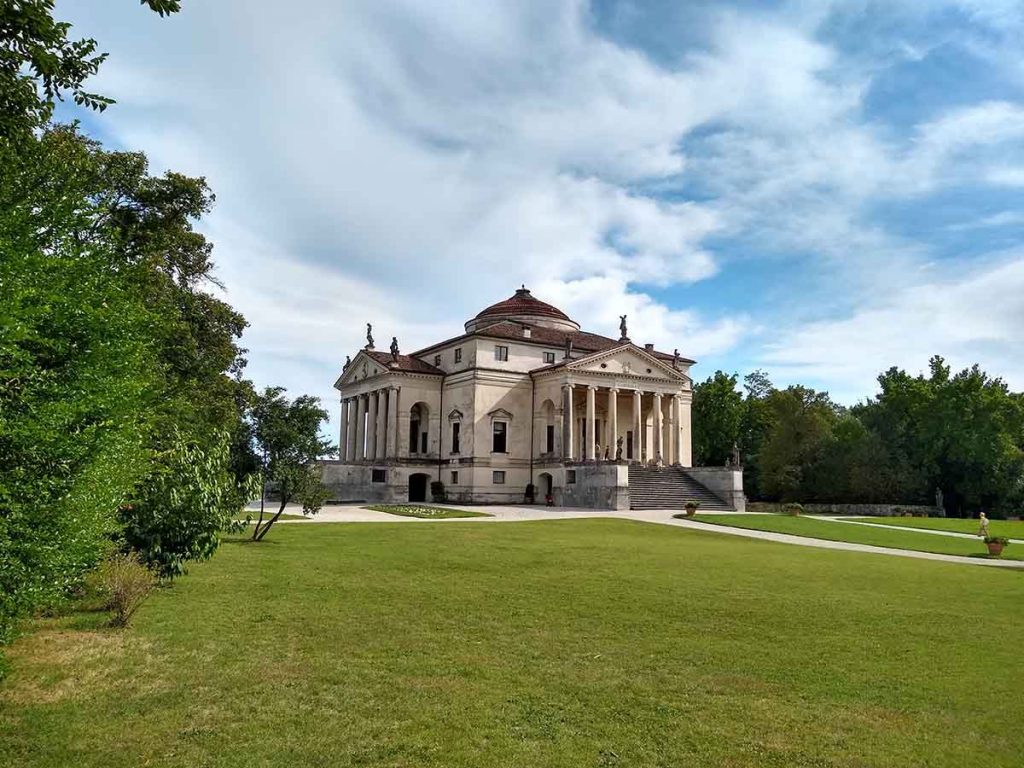
villa rotonda
andrea palladio
vicenza
1592
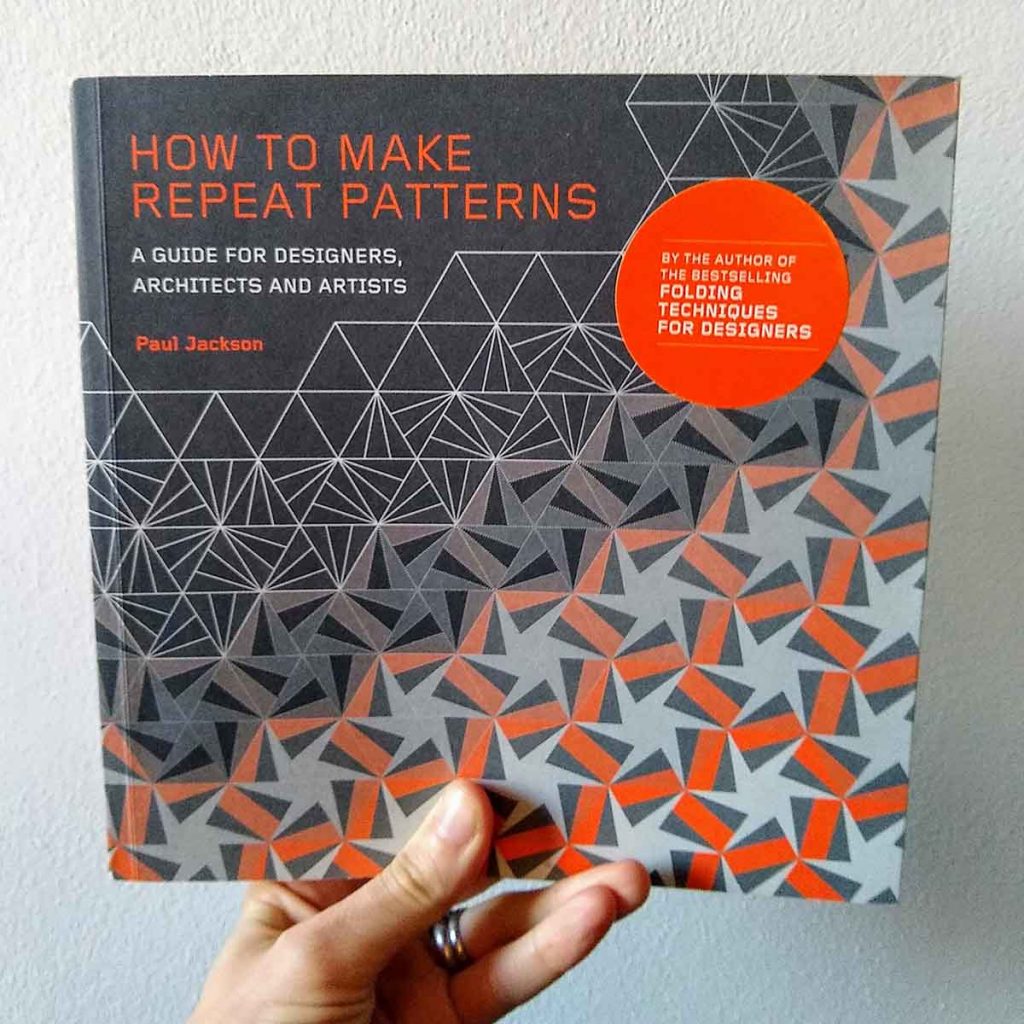
I have gone down the symmetry rabbit hole a few times, and it is endlessly fascinating. An amazing book by Paul Jackson How to Make Repeat Patterns goes into a great amount of nerdy detail explaining the different types of mathematical symmetry.
I think it would surprise you to know that most of the time things that we think of as asymmetrical are in fact symmetrical.
The four types of mathematical symmetry produce staggeringly unsymmetrical looking outcomes. They are rotation, translation, reflection and glide reflection symmetry, in case you were wondering.
how to make repeat patterns
paul jackson
a nerdy deep dive into symmetry and repeat pattern making. highly recommend.
You don’t need to go far to consider asymmetry disguised as symmetry. Think of our own bodies. We always assume we are symmetrical, two eyes, two arms and legs. A line that we can run down from head to toe that divides us into two equal sides. But think internally… We have one heart, on the left side. Other organs placed on the right. In fact we are anything but symmetrical. I know from garment making that I have one leg that is longer than another (my mother too). I thought it was my wonky sewing, but nope, turns out that hem was perfect, it was my body that was a little skew-iff.
balance + design
Symmetry is one way of looking at balance, but what other roles does balance play in art and design?
From the J Paul Getty Museum:
Balance is the distribution of the visual weight of objects, colors, texture, and space. If the design was a scale, these elements should be balanced to make a design feel stable. In symmetrical balance, the elements used on one side of the design are similar to those on the other side; in asymmetrical balance, the sides are different but still look balanced.
So, it’s not just about the shapes we see, but the visual weight they hold. Think of a page with two circles. One black, one white. If they are the same size, there is some visual symmetry in the size, but they are unbalanced as one (the black circle) holds much more visual weight than the white if the background is also white. Here color plays an important role.
What about in a quilt where texture is used?
Does an unquilted area hold the same visual weight as a densely quilted textured area? Is it a greater or a lesser weight? Does it depend on the color of the thread? Or the colors and shapes in the rest of the composition?
is balance always good?
Let’s take another stance. Do we always want to produce balanced designs? What does an unbalanced design convey? Disharmony, discord, or some other meaning?
I have been exploring balance in some recent compositions. Offsetting a large dark shape with a much smaller one. The difference in the size of these shapes, the unbalanced, is exactly what I want to convey. Here’s an example of what I am talking about:
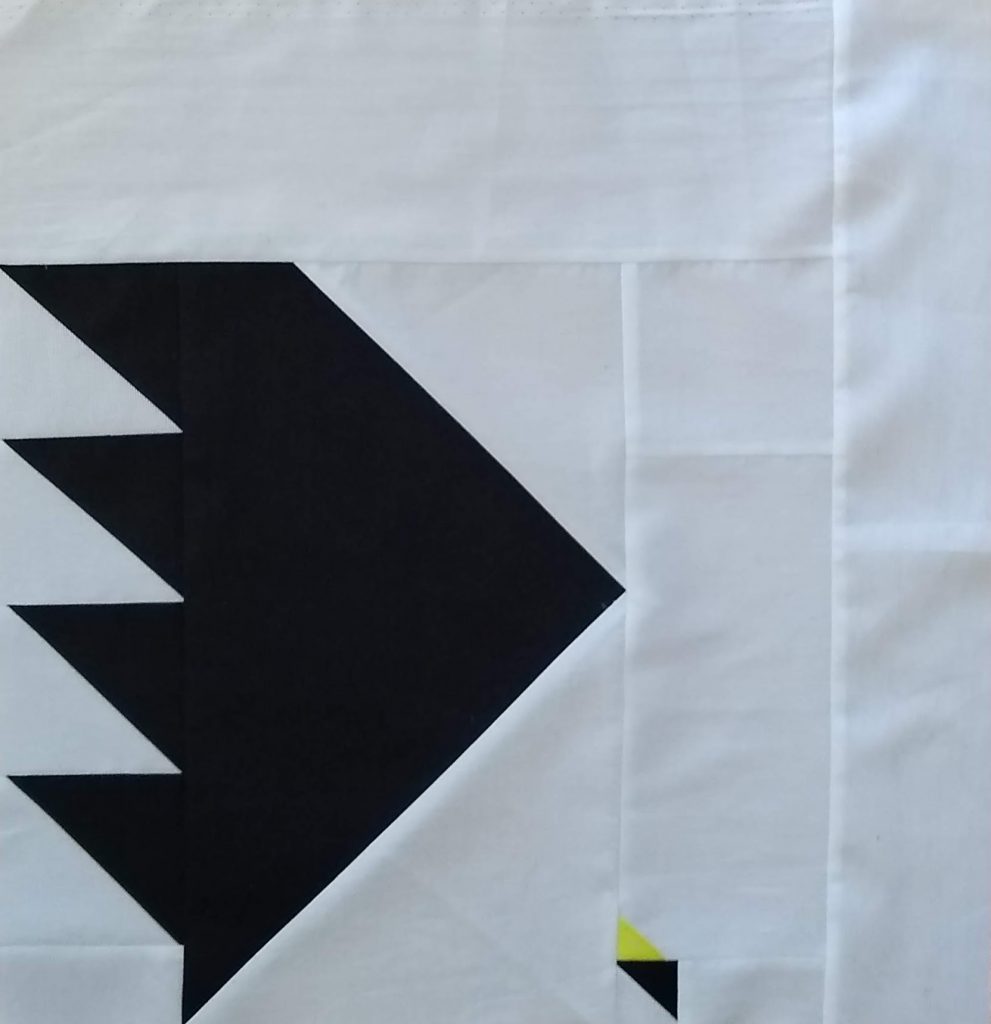
b/w study no.2 – flight/protection
ally ryde
cotton. machine pieced. applique.
18×19″ – 2022
What I am trying to evoke here is a sense of dominance, of towering over, of protection of, of sheltering that the large figure on the left holds relative to the small figure on the right.
It’s not balanced. But that is on purpose.
balance + our brains
I think we naturally seek out balance and symmetry. It’s something our brains are wired to seek out. Our eyes and brains look for a repeating pattern or seek to fill the gap if a pattern leaves out a line or skips a beat. This probably has to do with minimizing brain power needed to take in all the information around us. Instead of processing it all, we simply assume or extrapolate from what we see, so we can more efficiently process the information and assess risk (fight/flight).
But that is delving into the realm of perception and brain science, well beyond my expertise. My own experience is based in pleasure from seeing a harmonious symmetrical building such as Palladio’s Villa Rotonda but also my reaction to something like Boccioni’s Unique Forms of Continuity in Space, which in my mind I cannot resolve as symmetrical, but I love all the same.
unique forms of continuity in space
umberto boccioni
bronze – 1913
a poster of one of my all times favourites
As far as the balance of creativity/life/work/family/mind/body, well, that is something also unresolvable I think. And is it really something to solve in the first place? Maybe this is also a case when unbalance is acceptable. Afterall, don’t we get bored with the same everyday? Don’t we actively seek out unbalance? Thrills, wild rides, unevenness, excitement. What is excitement if not an unbalance, a peak on the graph so to speak.
Food for thought on this equinox day. Enjoy your balance or lack thereof wherever you may be.
So good.. wondered where you were going because isn’t symmetry and balance oh sooo beautiful! Thought you might touch on Chaos theory.. I’ll send you the name of the book i have on it.. that’s my balance that’s not balance. I do like the balance that’s unresolvable, for someone who also loves to SOLVE.. to figure out and nail it there is huge comfort in the idea that ‘That is exactly how its supposed to be.’ I’ll stop trying to find the perfect balance work/life… well for tomorrow anyway.
Ooh yes, great thoughts. I’ll have to look into Chaos Theory for sure. Thanks for leaving a comment!
Your designs and inspirations are fascinating and unique!
Thank you so much Denise!