Get your FREE GUIDE '7 Steps to grow a Quilt Pattern Design Business'

processing ideas
So, you’ve had a great idea in the middle of the night. Now what?
So, you’ve gathered some inspiration. You’ve had a great idea in the middle of the night. Now what.
How do you process your ideas?
Imagine you just got back from Quiltcon, or that exhibition at such and such a museum. You’re just fizzing with ideas, brimming over with inspiration and have all these connections whirring in your mind. You want to ride that energy and harness it to your creative wheel. But instead, what happens? You spend a few days buzzing, maybe rushing about trying to grab a bit of this or that, then real life takes over again and the buzz gradually wears off mixed in with the daily grind. Sigh.
But what happens to all these ideas you started? Where do they go? Poof – into the ether?
Maybe there’s a way to get them down on paper, keep track of them and use them when you need to. Build your own repository of ideas. A bank. A warehouse. A storage facility. Your own treasure chest of ideas, ready and waiting for that rainy day, future proofing you against the dumps, the block, the blank canvas. Your secret weapon in the fight.
how do you store ideas?
I like using a sketchbook. Actually, many sketchbooks. Each has a different purpose. I try to keep a small tear-able pad of paper (one with a perforated edge) with me when I am on the go, that way I can sketch something down quickly and easily paste it into my larger studio sketchbook once I am back in the studio. You can see me using it in this video
I also like to have a smaller version around the house with me, instead of dashing to my studio to grab my big one, I can grab my smaller one, and head to the garden, or out on a walk, or just try to capture that shadow that is quickly falling with dusk across the kitchen floor.
I have some large A4 sketchbooks – heavier weight paper for mixed media and further elaboration of ideas in watercolor or paint, or anything. These I normally keep in my studio along with my less portable art supplies. These larger formats also give you the space to iterate your idea – go deeper and really investigate what it is that you are trying to say. I expand a little more on what I mean by iteration in my other journal post inspiration.
I also love using my Traveler’s Company sketchbook. It is an insert for my Traveler’s notebook, which I use for journaling and reflection. Plus, it’s just a beautiful object to keep on hand, and it was a special gift.
Here are some of my favorites. Seek them out at your favorite local stationer, or find them online.
Sketchbooks are so personal, it’s really a matter of what you like and find comfortable to use. I would consider
- weight of paper (for bleed through, etc.), depending on what media you use (pen, pencil, watercolor, alcohol pens…),
- size/weight – do you need yo carry them around? Or use them in the studio? Hold them up to sketch with, or use them on a desk/table?
- whether they lay flat when open or not (spiral bound, stapled, glued…)
- if they have perforated pages or not – do you want to be able to neatly tear your sketches out and paste them somewhere else, or even frame them?
- availability – can you get more of these? Do you want a consistent/uniform collection of notebooks or is haphazard ok with you?
let’s get digital, digital…
What about visual inspiration we try and capture with our phones? Who doesn’t have a photo roll full of photos, that well, just sit there?
I like to approach it in a few ways. I categorize my photos on a weekly basis (it used to be monthly, but that was too much like a steep and slippery slope, because let’s face it, who wants to sit down and go through a months worth of photos at the rate we take them these days… )
This gives me the chance to review. An important part of my working process. What worth does a picture have to me if it stays there on my phone unlooked at? It is worth it to go back and review, asking is that image still as important to me as when I first snapped it? Does it belong in a series with other photos? Is this a new area I am exploring? Is it in the same vein as something I have photographed before?
Do I even remember why I took that photo?
I also have a series of albums on my phone, called things like ‘shadows’ and ‘abstracts’, or colors’. Sometimes the same photo can appear in more than one album. This way when I am looking for something that is ‘black and white’ or ‘yellow’ I know where to look. The same photo might be in ‘patterns’ or ‘abstracts’. This is a very personal categorization. Do what works for you and the way you associate images.
quilting projects.
For quilting and textile projects I like keeping my ideas a bit more organized once I have fleshed out the idea further. Maybe I saw an amazing quilt on Instagram , or at Quiltcon, and I want to remember something specific about it. But of course I don’t want to copy it, so something I do is ‘process’ it.
I might ask myself these questions:
What attracted me to it in the first place?
What held my attention?What technique/shape/colour/element am I specifically interested in/attracted to?
How can I take that element and translate it into my own work?
How can I incorporate it into what I am making?
How can it inform my next piece?
This might look like seeing someone using a combination of hand and machine stitching. You aren’t going to blatantly rip off their quilting design but you are inspired by the combination of the two stitching styles. So that can also go down on record for your project. And then it’s time to iterate it and take it further away from the source of your inspiration and closer to your own creation.
what I use.
The design template I use is this one: You can get your copy here.
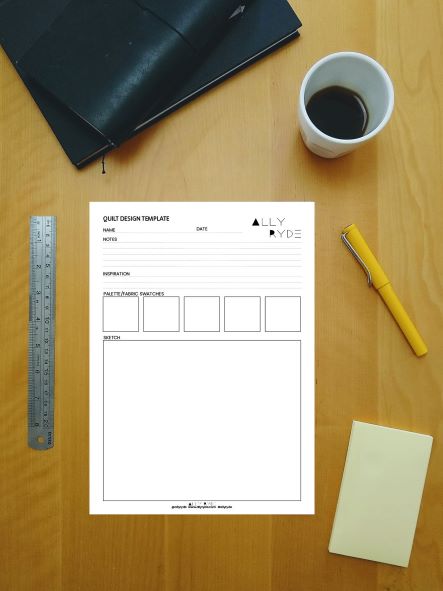
It gives me place to write notes, note down the source of inspiration, so I can credit it or at least reference it again. It has a place for a colour palette, or fabric swatches. I colour in pen, pencil, paint chips, whatever.
Sometimes I wake up in the middle of the night thinking of a colour palette and go sleep-walker style to my cupboard where my fabric stash is and pull some colours.
If I cut some swatches from these and attach them to my design template, at least in the morning I have a record of what I envisioned.
Most importantly, there is also space for a quick sketch. Maybe of the quilt as a whole, maybe of the beginnings for an idea for a block. The important thing is to make myself a visual reference that I can come back to when I have the time (on the weekend, in 3 weeks, in a year) and I can quickly see what my idea was and know right away if I want to pursue this idea further or not. I don’t have to go scrabbling around through pages of my notebook, I have a file with ‘future quilt ideas’ right here and handy.
what do we use these ideas for?
Stuck for what to make someone? Well, instead of jumping online for inspiration, you can leaf through you very own folder of inspiration and get started on a project that is unique to you. How special is that! You can browse your own warehouse for an idea instead of worrying that you are copying someone else. The ultimate way to make an heirloom gift for a new baby, a close friend or just for your own couch or wall.
Use this design template in conjunction with my guide ‘Design your own quilt in 5 steps’ to really kick start your design process AND keep track of all those ideas you are coming up with.
Ideas are a dime a dozen. It’s what you do with them next that makes them special.
What about you? Do you store your ideas? How? Leave a comment below.
In the first quilting years I stored my quilting ideas, and reflections on work done and their possible improvements during next steps, on loose paper sheets. Like writing a letter to myself . After months of this practice, the pile of sheets was 10 cm high… Then I moved to a new house (and I left my pile of sheets behind, without involving it in the relocation). Now I store ideas and possible new quilting projects in my mind. It helps me not to feel that I have a 10 cm thick list of UFO ideas. I recently allow ideas becoming forgotten. Tens of ideas may marinate, float and get lost in my mind, while I am still finishing one only quilt (and there is no time to start a new quilt yet). Shall the surviving idea be the one I will pick up after a quilt finish, when there is really time for something new to be started?
Paola, Thanks for your thoughtful comment. Wow, it is so courageous to trust that you will always have an amazing idea at the right time for that idea to be born. This is a revolutionary way to think about ideas for me. I am always scrambling to hold onto them, and then, like you said, you worry about the 10cm thick pile of ideas. I think I might give this a try! Thank you!