Get your FREE GUIDE '7 Steps to grow a Quilt Pattern Design Business'

inspiration
'Inspiration is for amateurs'. Is this true?
Inspiration is for amateurs.
Chuck Close
Is this true?
This is one of those quotes you read and smile wryly to yourself and go yeah, hmmmph. But then… I started really thinking about this statement. Is it true? What is the intention behind this statement? What does it really mean? Is inspiration for amateurs? Is this derogatory, or something else?
Let’s look at what an amateur is: there are really two branches of meaning in this word, aren’t there:
1. a person who engages in a pursuit on an unpaid rather than a professional basis.
synonyms: non-professional, layperson, enthusiast
2. a person who is incompetent or inept at a particular activity
synonyms: incompetent, bungler
Oxford Dictionary
There is the notion of a noble pursuit without compensation. And then there is the incompetent bungler. Which did Chuck Close allude to?
And then, inspiration. Isn’t this something uplifting and positive? Surely not something to be experienced by a bungler?
My interpretation is something like this:
Inspiration is for people who stand around and wait to be inspired. Staring at their blank page, just hoping some great idea will pop into their head while they sit passively there. (If this works for you, great!)
I think there is something a little more active about inspiration than just sitting around. And I think this is what Close was pointing to with his statement. Professionals, as opposed to amateurs, don’t wait for inspiration. They work. They practice their art. They are active in the process. Not passively waiting about.
This is the meaning I assign to this statement. That an artist is not some starving person in a garret, sequestered away in solitude, waiting passively.
Instead an artist is someone active, seeking inspiration, searching for an idea, pursuing knowledge and input that then informs their viewpoint and subsequently their work and their artistic output.
What implication does this have? Well, a significant one. It means the myth of the artist as genius is busted. Sure, not impossible, but much more likely that someone who is famous for their art or design or architecture has put in the work. They didn’t just have a lightning bolt idea out of the blue one day and ta daa became a noted artist.
This also opens to door to anyone, right? If the artist as genius doesn’t exist, if the successful artist is the outcome of work, and dedicated seeking of knowledge and inspiration, then you too (yes you! And I!) can be successful artists. As long as we practice, produce work that is meaningful, dedicate the time and effort it takes to seek inspiration, translate that, pass it through the black box of our minds and experiences and produce something on the other side.
the where.
So, where can we find this inspiration?
Well, everywhere. If you are not limited to sitting at your desk with your blank piece of paper in front of you, but instead have the whole world available to you for inspiration, go get it!
It could be a bit overwhelming starting from this point. Overwhelming to the senses if you start acquiring inspiration absolutely everywhere, to be sure. But let’s be clear: inspiration is everywhere. What you allow to be inspiration for you is much more discretionary.
So, here is an extremely non-exhaustive list of inspiration:
See… everything can be inspiration. You just need to look actively, seeking inspiration.
It’s also about developing an eye for inspiration. Tuning in to what really captures your attention, what catches your eye, what things drive your curiosity. What makes you stop and think.
What makes you stop and say ahhh.
What makes you stop and say eww.
One thing that is necessary for me if I am to be open to seeking and receiving input and inspiration, is to not always be ‘on’. So, not always listening to an audiobook/podcast/video. Not always talking, but sometimes listening. Not always looking but feeling. Tune in. When you go for a walk, do you plug in your headphones and ignore your surroundings? Or do you notice the crunch of your feet. The birds. The traffic, the smells, the changing light. Even the most mundane, everyday, repeated and repetitive walk in the most banal neighborhood can be full of stimuli. Cracks in the pavement, shadows of cars passing, slant of light from a building, bare earth, patina of concrete.
the why.
Why capture this inspiration anyway?
You might already be working on something and not actively seeking inspiration with the express purpose of starting something new. Maybe you are feeling alert and open to experiences around you and are capturing your inspiration to use at a future time, securing yourself against a potential time when you – gasp – run out of ideas (does this ever happen to you?). Maybe you are capturing something at the present time in order to return to it at a future time when you have more time/space/resources to investigate more fully.
the how.
Now you have a purpose for seeking inspiration and you’re tuned into finding inspiration, how do you capture it?
It is easy to whip out the old phone and snap a picture. I do this regularly. Then those photos sit there, and gather virtual dust, as I move onto some other thought, get caught up in whatever else was happening. Sketching something on the go is another way to capture your inspiration through a filter. Perhaps a higher order filter. Something that fixes the idea more firmly in your mind, that allows you to process the idea in the moment a little more deeply than just taking a photo might. A filter that is maybe one step further than filtering your view through a viewfinder. There is room for both types of capturing. And many more.
I would love to know how you capture inspiration (leave a comment!)
A small thumbnail, a quick abstraction. It’s not about recreating what a photo would capture, but about capturing your idea. Is it the contrast between the bright light and the shadow? Dark vs light. Is it the shape? Or shapes? Is it something you can write down instead of sketch?
the what.
Now we’ve got a way to capture this inspiration, what do we do with it?
I like to review my inspiration, store it. I use albums on my phone for different themes (texture, shadow, colour are some). I go through my photos when I get a chance. Ideally weekly, more realistically monthly.
My sketchbook is another way: I write notes, expand on ideas, categorize them. I keep an index at the front of my sketchbook, kind of like you would in a bullet journal so I can reference relatively easily an idea I might return to look for at a future date. Over time, a repository of ideas builds up.
How do we use inspiration?
If you are ready to start working, it’s time to iterate. And go deeper.
Take that idea, that inspiration, that sketch, that photo and iterate. What do I mean by iterate? I mean go deeper. Change one small thing and see what difference it makes. Change a big thing and see what difference it makes. Alter the shapes, the edges, flip the value (dark to light, light to dark), make it in crazy colours. Think of similar things. Think of opposites. Take the next logical step. Take the next illogical step.
And repeat. Do it again. Iterate.
A path for iteration might be a 100 days project. Here is an example of 100 days of HST (half square triangles, a quilting block) iterations. I played with a very limited palette, a small square, and explored the possibilities of this, one small increment, one small iteration at a time.
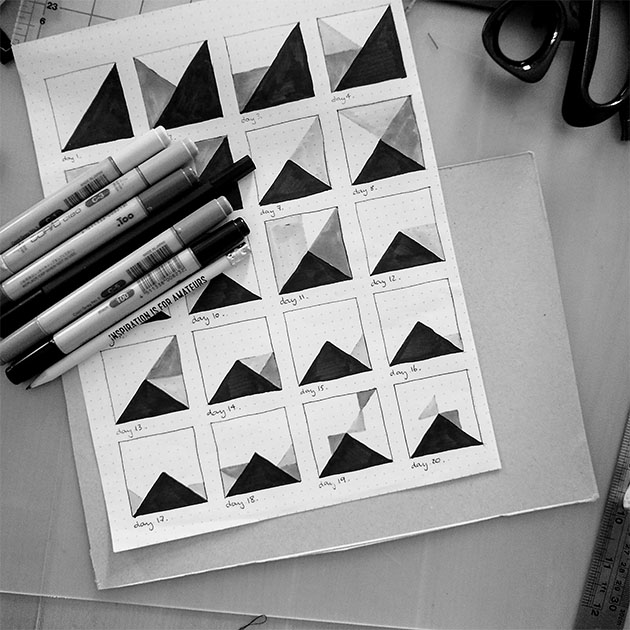
This doesn’t have to be a super long drawn-out experience. I was sitting one morning and I noticed a shadow on the cornice in the room I was in. I sketched it, and then iterated it a few more times right then and there. This idea is still sitting in my repository waiting for the next step, but you can see that in the space of 10-15mins you can seek, capture and iterate your inspiration source.
Iteration not only serves to help you investigate your idea, but also to abstract it, or transform it from what it was into something of your very own.
It might not look like the initial idea you had, or shape you were trying to capture, but now it is probably something better, something different, something yours. Yours alone. Only you, with your experience, with your eyes, with your way of seeing, capturing and iterating, could have arrived at this point.
The path from inspiration to outcome is one trodden by professionals. Not amateurs. People dedicated to the pursuit of an idea, with payment in mind. Not cash necessarily, but the reward of going deeper with their idea. Inspiration is for amateurs.
Seeking, capturing, reviewing, sorting, storing, iterating and building.
That is not for amateurs. That is for you. For the curious.
If you’d like a step by step on how I take something from an idea to a design, check out my guide ‘Design your own quilt in 5 steps’. It’s a high-level overview of the process I elaborated on in this journal post.
I’d love to know your thoughts. What is your take on inspiration? Leave me a comment below.
Inspiration, for me, is:
* A narrative, ie a story that resonates with me
* Fabric that “speaks to me”
If I’m really lucky, fabric and narrative just “fit”.
Then the hard work of designing begins!
Alix, isn’t it wonderful when the two combine! I love being able to tell stories with fabric. Sometimes the fabrics have their own stories to tell too, especially if they come from a special piece of cloth which holds memories (clothes or linens). Thank you for your thoughts!