Get your FREE GUIDE '7 Steps to grow a Quilt Pattern Design Business'

emulation
The fine line between copying and paying homage
Emulation
Homage
Appropriation
Copying
Stealing
Pirating
Where does your work fall on this spectrum?
How do you take what you see around you, your influences, and process them?
If you make a piece of work that is too similar, is it copying? Are you plagiarizing someone’s idea?
I referenced Austin Kleon once before on here. Probably his most well-known book is Steal Like an Artist.
The premise is that there is no original work. That everything comes from something.
Unless you are a true outsider artist (Olivia Laing writes beautifully about outsider artists) your work is influenced by what you see around you. Other artists work included.
Those quilts you looked at on Instagram yesterday, last week, last year? They’re all percolating in your mind.
So, how do you steal like an artist?
Well, own it. Be upfront about who your influences are. Don’t hide behind the pretense that what you are making is original. Name your heroes, call them out.
Pay homage. Emulate. But, most importantly, run the data through your own mind first. Put your spin on things. Choose your colours. Create your shapes. Make your combination.
There is only one you. No one else has the exact same makeup as you – experienced the same things, seen the same art, made the same associations between these disparate entities.
You are a curation machine.
Collecting input like a magpie, storing it away in your nest or your brain for you to tap into and use at some future time.
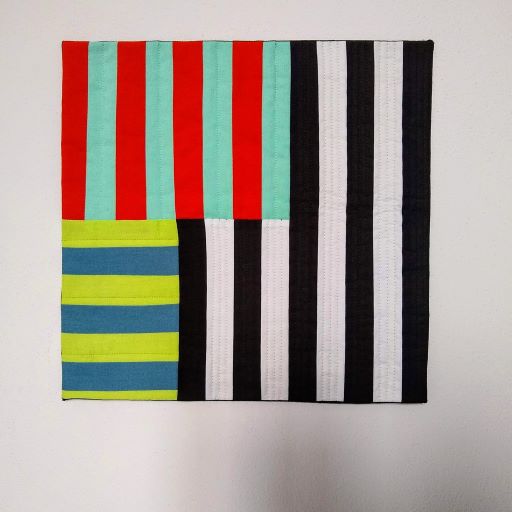
stripe study no. 1
cotton | machine pieced & quilted | 2022
12.5 x 12.5″
I made this stripes piece after my 100 days of stripes drawing challenge. I made it ages ago, and only just put a facing on it. In the meantime, after I had made this, I discovered the work of Sean Scully.
You might expect that this is deflating, coming up with an idea, only to find that someone else somewhere else is doing what you thought was only yours, but better, and more deeply than you. In fact the opposite is true. It feels like a validation. That my choices in subject matter and shape have been as interesting to someone else as to me. There is a kind of connection, a universality about it that allows you to feel connected to the world, as opposed to staying in your ivory (or concrete) tower and gazing out.
What about me you might ask?
There’s no way I could ever make something as good as XYZ artist.
Free yourself from the comparison.
You don’t and never will make art like anybody else. You will only ever make art like you make. Only you can be you. Your quilts are yours alone. Maybe this notion of freedom is even more accessible to us as quilters, with the almost infinite possibilities of fabric, colour, shape combinations that are possible in this textile realm.
Doubts… and possibilities
One common question people ask when talking about designing quilting patterns is, but haven’t all the quilts already been designed? How many more variations can there possibly be of Half Square Triangles, borders and blocks? How could I ever come up with something new?
Well, I challenge you: sit down and draw 3 quilt blocks. Using only HSTs. I guarantee you will come up with many more than 3 and realize the infinite potential of rotating, combining and translating this one simple shape over and over again. And this is just in 2 colours! Imagine when you introduce the next layer of intricacy and add colour. Choices only you would make.
This is the beauty of quilting. This is the possibility of quilt design. There’s room for you and your ideas too. Own your influences, create your work, share your ideas.
Perhaps Sean would have made quilts if he had made the ‘robe’ in fabric rather than paint!
Oooh – I like this idea! Though how you would get those kinds of layers with colour that Scully gets I don’t know. Dyeing? Overdyeing? Thanks for the comment!