Get your FREE GUIDE '7 Steps to grow a Quilt Pattern Design Business'
how to choose quilt design software
Let’s open up a GIANT cans of worms with this Tech Tuesday instalment: design software If you’ve been quilting for a while, you’ve likely come
Get your FREE GUIDE '7 Steps to grow a Quilt Pattern Design Business'
Get your FREE GUIDE '7 Steps to grow a Quilt Pattern Design Business'

Let’s open up a GIANT cans of worms with this Tech Tuesday instalment: design software If you’ve been quilting for a while, you’ve likely come

how to write a quilt pattern that connects with your customers
Determining the size of your quilt is one of the many design decisions you need to make to take your idea from paper to quilt. Don’t get overwhelmed! Think about these three factors and use the references and the quilt size chart here to help you make a decision with ease.
If you want to know what size quilt for a double bed, or you’ve ever looked up the quilt size for a queen bed, this journal entry has got your covered!
So, what do we need to consider when deciding on the size of quilt to make?
There are some obvious answers, but also some less immediate ones that I hope will spark your resourcefulness and ingenuity.

Is this quilt going to be used by someone? A real-life human being? If yes, then you might want to consider the actual size of the human in question. You make custom sized clothes when you are sewing. Why not make a custom sized quilt?
Sounds so straight forward but have you ever measured the person you want to make a quilt for? Are they shorter or taller than the average? Would they prefer an extra ample quilt to snuggle under, or are they looking for a more slim-lined/stream-lined version they can fold neatly out of sight on the arm of the couch?
When designing, architects and designers use a standard set of human dimensions, (something that ergonomics is also based on). These deal with averages, so use them as a guide, but if you are making a quilt for a specific person, take their specific measurements into account.

If you want to nerd out on cool stylized furniture and people, check out www.dimensions.com … so cool…
And this article on Arch Daily about designing for all types of people is fascinating too
Maybe you are making an improv quilt, or a scrappy quilt, or just trying to use up what you have in your stash. Can you get away with one less row on the quilt or even one less column?
I know from my experience that making some ‘throw’ size quilts, I end up with a giant, unwieldy heavy quilt that is hard to manoeuvre on the couch. Making a smaller less unwieldy quilt might be better in some cases, especially if you are making a quilt for someone who might not have the strength to wrangle a large quilt around.
The size of the mattress might factor into your design if you are making a quilt for a bed. So, what size bed are you making a quilt for?
And… here’s a bonus trick question: Is a King Size bed always a King Size bed?
You might not have spent a lot of time thinking about the different bed sizes that exist in different parts of the world, or you might have experienced this while you were on holidays and noticed the hotel bed was narrower/longer/shorter/wider than you would normally see back home (hopefully it wasn’t harder!)
When I first moved to Italy, we moved into a house that happened to have the exact same model of Ikea bed that we had in our previous house in Australia. We brought our queen sized bedding with us when we moved to Italy, thinking of course that it would be just the ticket!
So, that first day, you can imagine what kind of things I was saying as I was trying to yank our Australian queen sized sheets onto our European sized queen bed!!
I had this same experience when I was living in Indonesia. I had this giant bed which had a special shaped sheet on it. When I moved, I took my sheets with me too, not realising that for the next 10 years I would be tucking-in an extra width of this sheet to stop the fitted sheet sliding around, until I eventually had enough and cut off a width of the sheet and re-sewed it to the right shape (of course up-cycling the cut off fabric into a quilt…)
The world over, there are annoyingly different mattress sizes (if you move countries and want to keep using your same sheets). I can only assume these different mattress sizes developed based on manufacturing facilities in each area. Maybe they are even related to the building codes and standards for room sizes dictated by whichever government.
Here is a table of all the different sized mattresses the world over, for your nerding-out pleasure…
But more practically, here is an easy reference if you need to make a quilt for someone in a different part of the world.
I have also done a visual breakdown of the different sizes across the range so you can see at a glance the variations that exist.

Ta daa! Here is your very own common quilt size chart. I like to compare this to actual mattress sizes based on where in the world I am making a quilt for, just to make sure that a King really is a King and not some other kind of shape… But the basics are all here.
Download your own copy to print at home.

Another thing to consider when making a quilt for a bed is how much overhang you want to have. Things to consider include how deep the mattress is (ie how thick it is), whether the bed is on a frame or on a base with storage, if it is high or low (like a futon for example).
Do you want the quilt to cover the mattress only? The mattress plus the frame or box spring? The mattress down to the floor?
And… let’s get back to reality… This quilt is going to be covering people, right? Don’t forget the human element! What about the people who will be sleeping under the quilt? Will they have enough quilt to go around them so they can get nice and snuggled up?

There is one last factor to consider when it comes to determining the size of quilt you are going to make.
So, you want to make a giant quilt. Do you have the materials available to make it the way you want? Can you get a single piece for the backing at the size you need? Or will you need to piece it?
Some fabric manufacturers produce wide quilting fabrics called wide backs that are normally available in limited fabric print choices. Obviously these are woven on larger looms that the loom used to make the standard 44” wide fabric.

Think about sheets as well, you don’t have a sheet with a seam in the middle, so obviously it is possible to manufacture wider fabrics. Most patterns for apparel come with cutting directions for either 150cm wide fabric or 110cm wide fabric.
This variation in width is due to the size of the looms used to produce the fabric.
So, for a sheet or curtains, you can buy fabric that is 300cm or 118” wide.
Most quilting wide backs are produced at 108”. I can only assume this is related to loom and or printing restrictions and factoring in the shrinkage factor for cotton fabrics.
(Wow are we getting nerdy here or what!)
So, a single wide piece of quilting cotton can be 108” or 118” if you want to use sheeting material. Will this be the limiting factor in your quilt design?
What about batting that is available? What sizes is batting available in? Is there such thing as a batting size chart?
Hobbs and Quilter’s Dream two of the major batting producers have standard sized batting (refer to the table above) . You can also purchase batting in rolls of 15 or 30 yards depending on the manufacturer. This would allow you to cut down the batting to whatever size you need.
Now, what size batting do you get? Don’t forget to allow for at least 2 inches all around your quilt top, or up to 4 extra inches all around the quilt top if you are sending your quilt to a long arm quilter.
Do you purchase a big roll and cut it down to size as you need it, or purchase the exact size you need? Personally I buy the biggest roll I can and cut it down accordingly.
Stay tuned for a journal post on how to quilt sustainably including tips on using up all your batting scraps!!
So your limitations so far are size of single piece of fabric for the back (this assumes you don’t want to piece the back) and the size of the batting available.
This is all assuming you want to use a single piece of batting and a single piece of backing and are following a pattern or instructions for making your quilt.
Do you want to make a quilt using only the fabric you have in your stash or a set amount of scraps? Are you trying to avoid purchasing new fabric for a project? Are you planning on using a pre-cut bundle, if so, how big a quilt can you make using only that fabric? How much fabric do you need for a quilt?
The amount of fabric you have might be the determining factor in the quilt you design. Designing the quilt based on the fabric you have available to use in your stash or scraps could be a really innovative guideline to coming up with a unique quilt idea.
If you are working from a pattern, and only have a certain amount of fabric, you could consider removing a row or a column for the quilt pattern if you don’t have quite enough.
I often make quilts to a random size that approximates one of the standard bed sizes, or is sufficient to cover the human that will be using it (example: me or my husband, or my daughters).
I determine the size of the quilt based on the amount of fabric or scraps I have to use.
My Test Pattern quilts are made exactly like that. I start by sewing scraps together to make a new ‘fabric’. Based on how much stamina I have for scrap piecing, and/or how many scraps I have selected that coordinate or work well together, I then make the blocks from what I have.
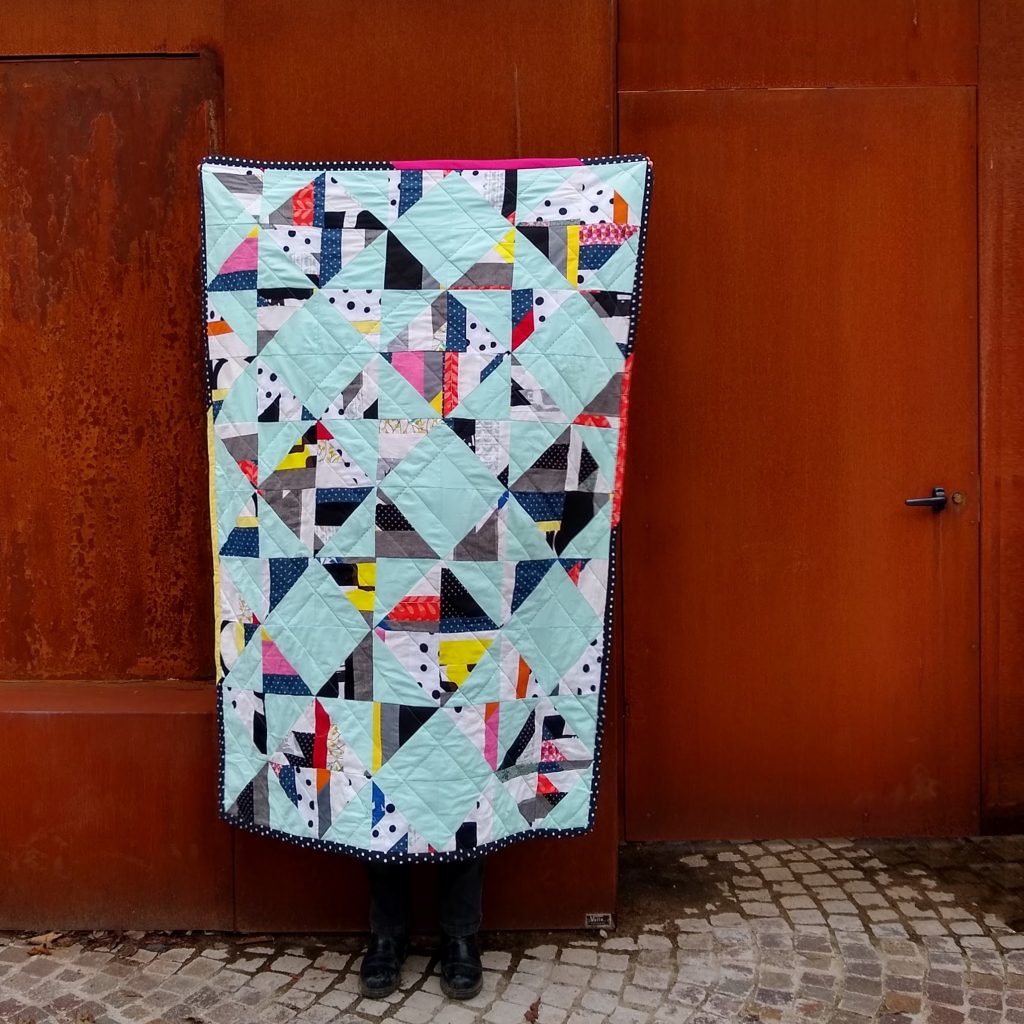
If you need to beef up the size of a quilt and you don’t have enough of the right fabric or scraps in your stash for the blocks or piecing, consider adding sashing or borders instead of rushing out and buying more fabric.
What if you want to do things more sustainably? Using what you have, not buying anything new and making quilts in the way they used to be made: with what was available, what had to be used up, repurposed or upcycled from the materials on hand. Stay tuned for a post next week that goes deep on how to quilt from your stash and how to use materials from alternative sources.
To wrap things up here (pun intended)… Always remember that unless you are making an art quilt to hang on the wall, a person will be using your quilt. That factor is the single most important factor in determining the size of quilt to make. Yes, it’s wonderful if the quilt looks good on a bed, but if it’s not practical for the person it was designed for, are they going to enjoy using it?
Factoring in your available materials is also a significant contributing factor to the decision of what size quilt you are going to make, especially if you want to quilt sustainably (for your wallet and the planet..)
